Following several months of implementation, the “STEAM4EQUALITY: Inclusive EdTech Labs – STEAM and Digital Education for Every Child” project has been successfully completed. One of its key outcomes is the new online module “Marketing and Design”, now available to all primary and secondary school students in Montenegro through the Digionica platform.
ABOUT THE PROJECT
Junior Achievement Montenegro (JA Montenegro), in partnership with UNICEF and the Ministry of Education, Science and Innovation of Montenegro, implemented the “STEAM4EQUALITY: Inclusive EdTech Labs – STEAM and Digital Education for Every Child” project from November 2025 to June 2026.
The project aimed to strengthen the digital competencies of students and teachers, promote modern STEAM and EdTech approaches in education, and create equal educational opportunities for every child, with a particular focus on the inclusion of Roma and Egyptian children and reducing the digital divide.
The project involved six primary and secondary schools from Podgorica, Nikšić and Berane and was implemented through four phases – from student consultations and teacher training to student workshops and mentoring support for the development of student projects.
PROJECT RESULTS
The project began with student consultations involving more than 300 young people from six schools, exceeding the planned number of participants by more than one third. Around 100 participants were students from Roma and Egyptian communities. Their responses regarding their interests, habits and challenges in using digital tools provided the basis for the next stages of the project.
Based on these findings, three specialised training sessions were organised for representatives of all six schools – teachers, ICT coordinators and Roma/Egyptian mediators – focusing on the Digital School concept, working in EdTech Labs and online safety.
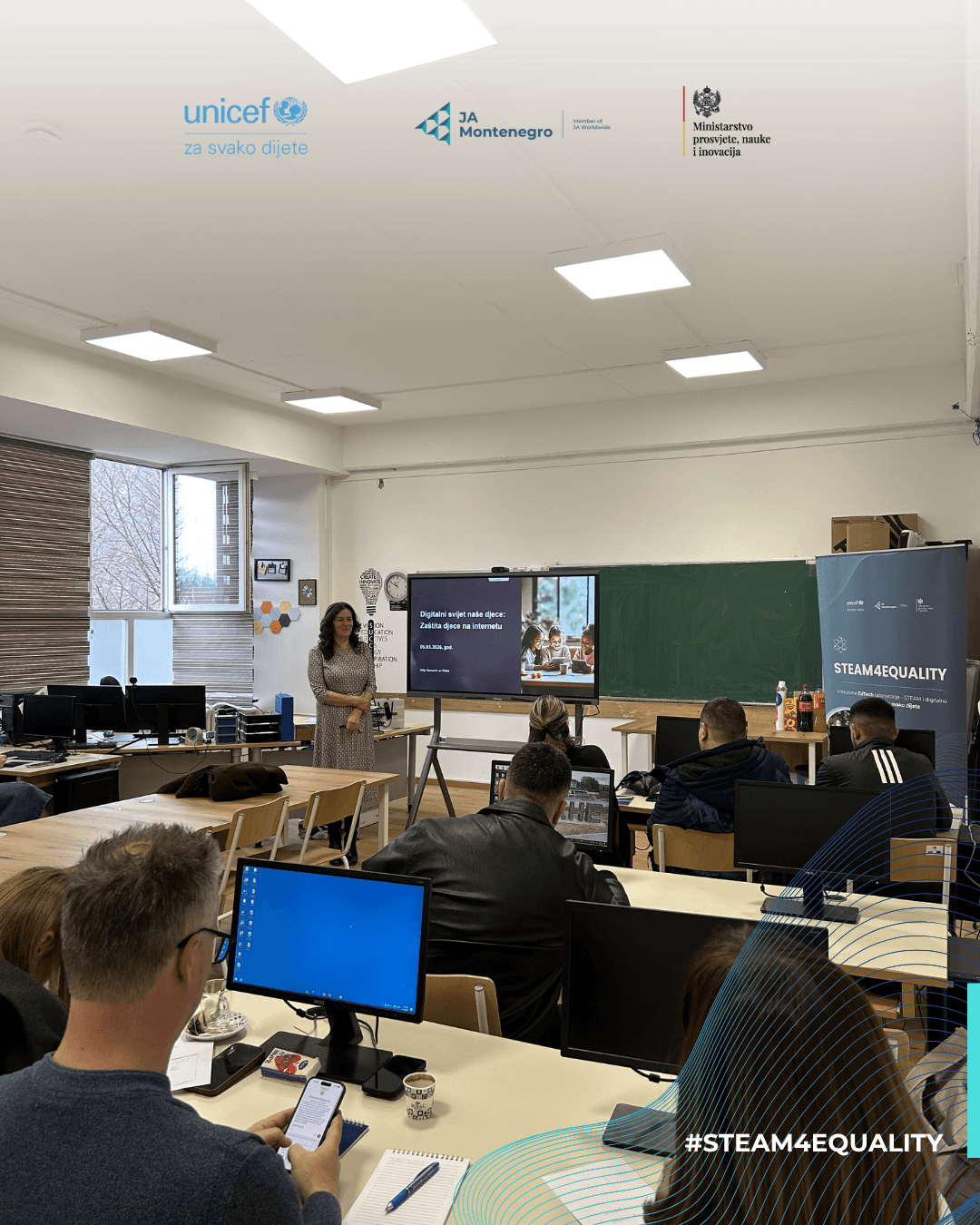
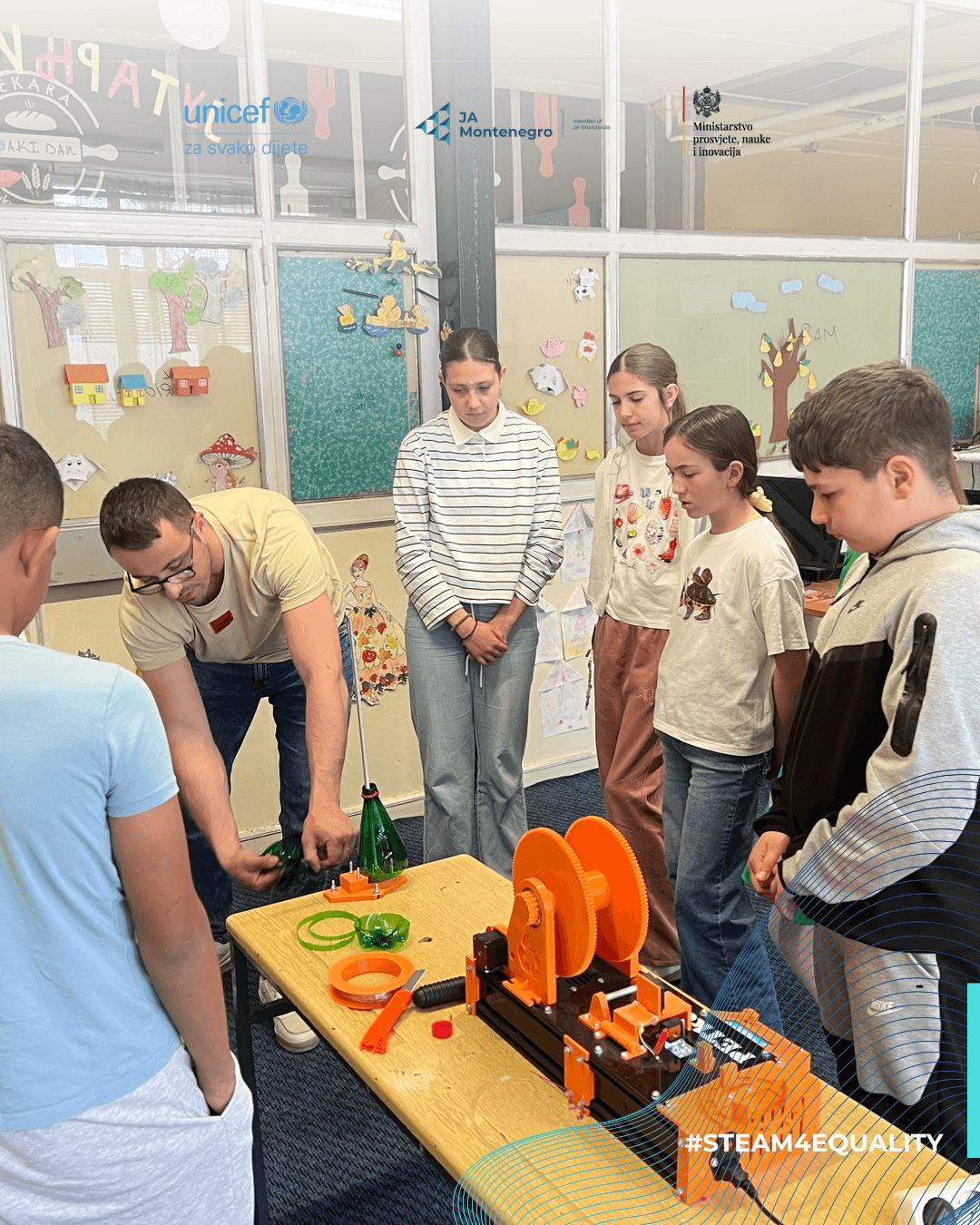
The trained teams then delivered student workshops across three modules: Office 365, Digital School/Digionica and EdTech Lab. Around 100 students participated, with an almost equal number of girls and boys and significant participation of children from Roma and Egyptian communities. Through these workshops, students had the opportunity to work with modern digital equipment and explore 3D modelling and printing, among other activities.
At the same time, six student teams received two months of mentoring support. With the guidance of their teachers and mentors, the teams identified challenges within their school communities and developed their own solutions, preparing to present them at the Digital Innovation Forum in June 2026.
STUDENT DIGITAL COMPETENCY RESEARCH RESULTS
The analyses conducted as part of the project showed that although the majority of students have access to digital devices and the internet – 85% in primary schools and 68% in secondary schools – their digital competencies remain largely focused on basic search and communication skills. Skills related to more advanced tools, such as advanced Excel functions, cloud services and the Digionica platform, were considerably less developed.
At the same time, as many as 65% of primary school students expressed an interest in learning about artificial intelligence, while secondary school students identified programming, digital marketing, web design and graphic design as priority areas of interest.
PROJECT OUTCOME: NEW “MARKETING AND DESIGN” MODULE ON DIGIONICA
Based on the project findings, and particularly the strong interest students expressed in marketing and design during the consultation process, a new online module, “Marketing and Design”, was developed. The module is now available to all primary and secondary school students in Montenegro through the Digionica platform.
The module provides practical knowledge and skills that students can apply at school, in student projects, when developing entrepreneurial ideas and in everyday digital communication. Through carefully designed lessons, students learn the fundamentals of visual identity, creating promotional content, digital marketing, developing creative campaigns and using modern design tools.
In this way, the knowledge and experience gained through the STEAM4EQUALITY project will remain available beyond the project’s formal completion, reaching a much wider group of students and teachers across Montenegro. All students and teachers are invited to explore the new module on Digionica and further develop the creative, digital and entrepreneurial competencies that are becoming increasingly important in modern education and the labour market.
STATEMENT FROM THE PROJECT TEAM
“The consultation results clearly showed that students want practical and creative knowledge that they can immediately apply at school, in their projects and in their future careers. Launching the ‘Marketing and Design’ module on Digionica is a direct response to what students told us and another step towards building digital education that is accessible to every child,” said the project team at Junior Achievement Montenegro.